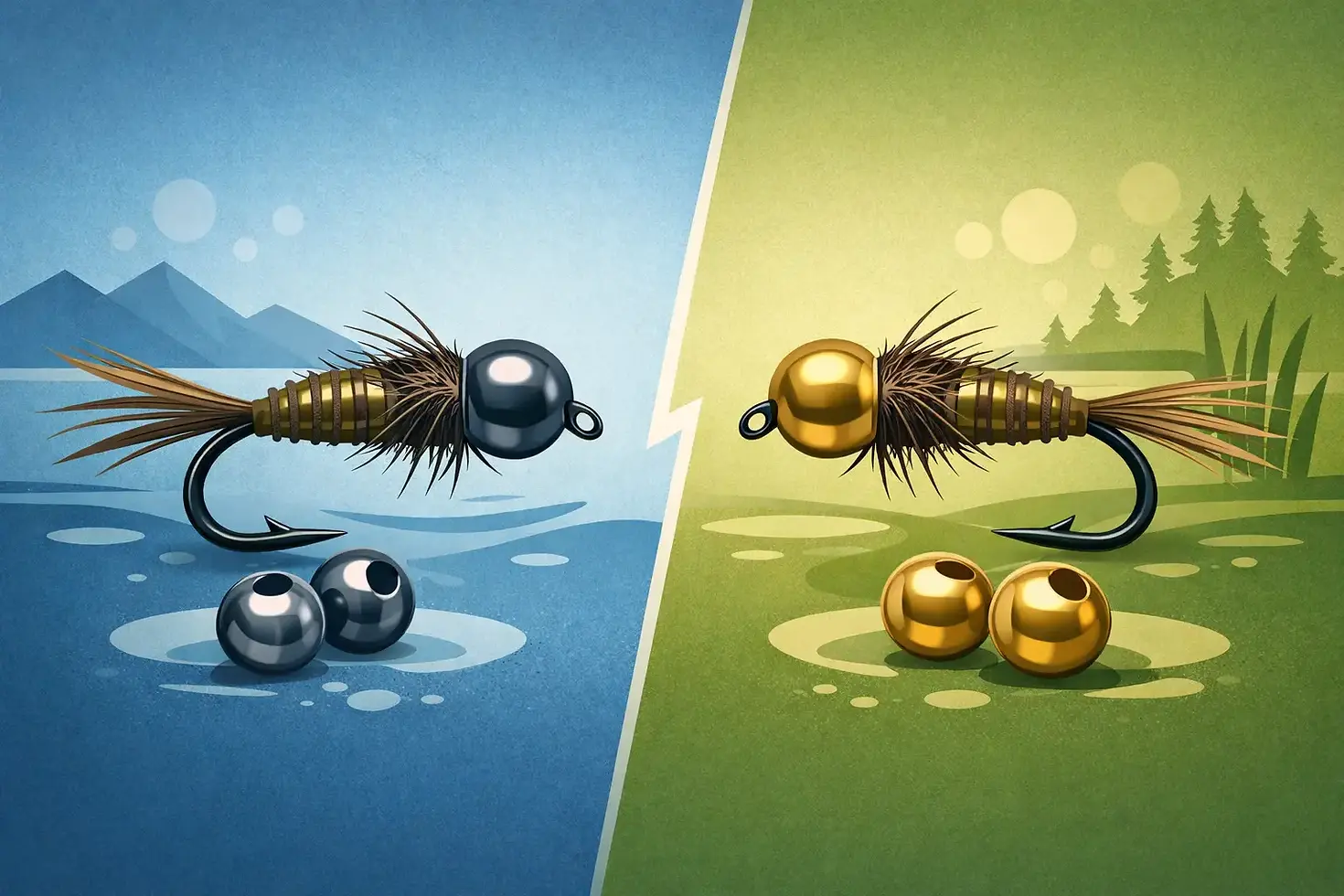
Tungsten Beads vs Brass Beads for Trout Nymphs

A beadhead nymph can look perfect in your fly box and still fish poorly if it rides six inches above the trout. That is the real decision behind tungsten beads vs brass beads. Both have a place on proven patterns such as Pheasant Tails, Hare’s Ears, Perdigons, and Zebra Midges, but they do very different jobs once the fly hits moving water.
For most trout anglers, the choice comes down to depth, current speed, fly size, and budget. Tungsten gets a fly down quickly. Brass adds useful weight at a lower cost and can be the better match when a nymph needs a more natural drift in shallow or moderate water. Choosing the right bead is less about buying the “best” material and more about putting the right fly in the feeding lane.
Tungsten Beads vs Brass Beads: The Main Difference
Tungsten is much denser than brass. At the same bead diameter, a tungsten bead weighs roughly twice as much as a brass bead. That added density is why a small tungsten-bead nymph can reach the bottom in a fast pocket or deep run without turning the entire rig into a bulky mess.
Brass is lighter, less expensive, and still offers enough weight for plenty of fishing situations. A brass-bead size 16 Pheasant Tail can be an excellent searching nymph on a freestone stream where the water is knee-deep and moving at a moderate pace. It enters the water softly, drifts naturally, and does not always require a heavy indicator rig or extra split shot.
The difference becomes obvious when conditions get demanding. If you are fishing a deep tailwater seam, a swift mountain run, or the heavy current at the head of a pool, tungsten helps get the fly down before the drift is over. Brass may never reach the trout’s level unless you add weight elsewhere in the setup.
Why Tungsten Beads Catch More Fish in Fast or Deep Water
Tungsten’s biggest advantage is efficiency. Rather than stepping up to an oversized bead or piling on split shot, you can fish a compact nymph that sinks quickly and still resembles a familiar aquatic insect. This matters with small patterns. A size 18 or 20 tungsten Zebra Midge can reach depth far better than the same fly tied with brass, while retaining the slim profile trout expect from a midge pupa.
That faster sink rate is especially useful for tight-line nymphing. When you are leading flies through fast current with a Euro-style setup, getting the point fly near the bottom quickly is often the difference between occasional contact and consistent takes. Tungsten beads also help when you need to keep your leader and tippet under control in conflicting currents.
Tungsten is not automatically the right answer, though. A very heavy fly can snag bottom constantly, particularly in shallow pocket water. It can also create an unnatural presentation if it drops too abruptly in skinny water where trout are feeding just below the surface. In those situations, a brass bead or an unweighted nymph may drift better and produce more looks.
Best uses for tungsten-bead nymphs
Fish tungsten when depth and speed are working against you: fast riffles, deep runs, plunge pools, high water, and cold conditions when trout are holding close to the bottom. It is also a smart choice when you want to fish smaller nymphs without sacrificing sink rate.
A tungsten-bead Perdigon, Frenchie, or jig-style Pheasant Tail makes a dependable anchor fly. Pair it with a lighter dropper such as a soft hackle, midge, or caddis larva, and you can cover both the bottom zone and the water just above it.
When Brass Beads Are the Better Value
Brass beads deserve more credit than they get. They are economical, durable, and effective in the conditions many recreational trout anglers fish most often. If the stream is shallow to medium depth and the current is not pushing hard, a brass-bead nymph may reach the strike zone just fine.
They are also useful when you are building a broad, affordable fly box. Stocking several sizes and colors of everyday nymphs lets you adjust to changing water and insect activity without overspending on every pattern. For anglers who lose flies regularly to rocks, logs, and undercut banks, brass-bead flies offer practical value.
Brass is often a good choice for dry-dropper fishing. A lightly weighted nymph below a buoyant dry fly is easier to cast and less likely to drag the dry underwater. On a clear summer creek, a brass-bead Hare’s Ear or Pheasant Tail beneath a hopper or attractor dry can be exactly enough weight to get a convincing drift without hanging up every few casts.
Best uses for brass-bead nymphs
Choose brass for shallow runs, gentle riffles, clear low-water conditions, and dry-dropper rigs. It is also a sensible option when trout are feeding in the middle of the water column rather than tight to the streambed.
Brass works well as the upper fly in a two-nymph setup, too. Let a heavier tungsten point fly establish depth, then use a brass-bead nymph above it to imitate a mayfly nymph, caddis larva, or emerging insect drifting slightly higher.
Bead Size Matters as Much as Material
Material is only half the equation. A large brass bead can weigh more than a small tungsten bead, so do not choose by material alone. Bead diameter, hook size, wire thickness, and the fly’s body materials all affect how a nymph sinks and tracks.
A common mistake is adding the biggest tungsten bead that fits the hook. The fly may sink fast, but an oversized bead can distort the profile, crowd the hook eye, or make a smaller natural imitation look clumsy. A slender size 18 midge pattern usually calls for a bead that matches the hook and preserves the fly’s proportions.
For a practical starting point, match bead size to the pattern and then adjust material for water depth. Use tungsten when you need more weight without increasing bead diameter. Use brass when a standard-sized bead provides sufficient weight and a more controlled descent is helpful.
Bead colors also play a supporting role. Gold is a reliable all-around choice for mayfly and caddis nymphs. Copper can provide a subtler look in clear water, while black or matte tungsten beads are excellent when you want less flash. Bright colored beads can trigger strikes on high-water days or when trout respond well to an attractor pattern, but they are not mandatory for every fly.
How to Choose the Right Bead on the Water
Start with the water, not the fly bin. Look at current speed, depth, and where you expect trout to hold. In a three-foot-deep run with a hard current, a tungsten-bead point fly is usually the practical move. In an ankle-deep creek with spooky trout, a lighter brass bead may keep your presentation from looking and sounding too aggressive.
Pay attention to your first few drifts. If your indicator barely pauses and you never touch bottom, add weight, shorten the distance between indicator and flies if needed, or switch to tungsten. If you are snagging every drift, lighten the rig, move to brass, or fish a smaller bead. Productive nymphing is often a series of small corrections rather than one perfect setup.
There is also no rule saying every fly on a rig must use the same bead material. Many effective rigs combine both: tungsten below for depth, brass above for a more natural secondary presentation. That approach gives you coverage without making the whole system unnecessarily heavy.
Build a Fly Box That Covers Both
A useful trout nymph box includes both tungsten and brass versions of core patterns. Keep tungsten-bead Perdigons, Zebra Midges, Pheasant Tails, and jig nymphs for fast and deep water. Add brass-bead Hare’s Ears, Pheasant Tails, copper-bodied nymphs, and caddis larva patterns for shallower drifts, dry-dropper fishing, and everyday prospecting.
Discount Quality Flies focuses on the practical side of that decision: proven patterns in the sizes anglers actually need, without treating a well-stocked fly box like a luxury purchase. Carrying both bead styles gives you a simple way to adapt when the river changes from a slow glide to a heavy run.
The best bead is the one that puts your nymph in front of feeding trout at the right depth without ruining the drift. Start with the current, make a few honest adjustments, and let the water tell you whether tungsten or brass belongs on the end of your tippet.


